
Knee conditions
We provide treatment for a wide range of knee conditions
Scroll down for more information on the different causes of knee pain that we can support you with
There are numerous reasons you could be suffering from pain in the knee region. Each one will require a different approach to treatment and follow a different path to recovery
Under each of the headings below you will find more information on the nature of a range of common knee problems that we would see in clinic
Meniscal Tear
Inside your knee you have two meniscus, a medial or inside and a lateral or outside. They help to control the smooth movement of the knee and absorb force when running, jumping and generally moving around. These can get injured with twisting or pivoting movements, following a fall or can become degenerative or worn with age.
Some meniscal tear have the ability to recover over time but can be slow. Some people can get problems with catching and locking in the knee as a result of these. Some can have a feeling of giving way.
In the early stages after injury or the onset of symptoms it is important to get full movement back. If this is a struggle or is very reduced referral for an MRI scan could be indicated.
Treatment will be about restoring range of movement, maintaining or improving strength in the leg and restore confidence in using the leg again.
ACL injury; with or without surgery
Most people will have heard or a footballer injuring their ACL. The ACL or Anterior Cruciate Ligament is a stabiliser in the centre of the knee. It controls the shin/Tibia and thigh/Femur bones and prevents the shin bone moving forwards on your thigh.
It can be injured either through a contact injury with the foot stuck to the ground and a force to the knee or in a noncontact injury when the foot is fixed and you twist the knee. Often people will describe hearing or feeling a pop at the time of injury. This is often accompanied by lots of swelling quickly. Some people will have a sense of the knee giving way after this when walking or trying to twist on the knee. People can injure the meniscus or MCL (Medial Collateral Ligament) on the inside of the knee at the same time. An MRI can help confirm the injury and often people will have a discussion with a Knee Surgeon about the options. Some people can manage really well without surgery and good rehabilitation. Others will need surgery to help them get back to day to day function or their sports, particularly if this involves changes of directions and twisting movements. There are several common graft types that can be used to reconstruct your ligament and your Consultant will discuss which one may be the best in each case.
Rehabilitation will follow a milestone based approach involving restoring range of movement, building strength and control, regaining fitness, building up jumping, hopping and running before exposure to sporting movements and eventually a graded return to training and competitive play. This process can often take 12 months or more,
Anterior Knee Pain (Patellofemoral pain sydrome)
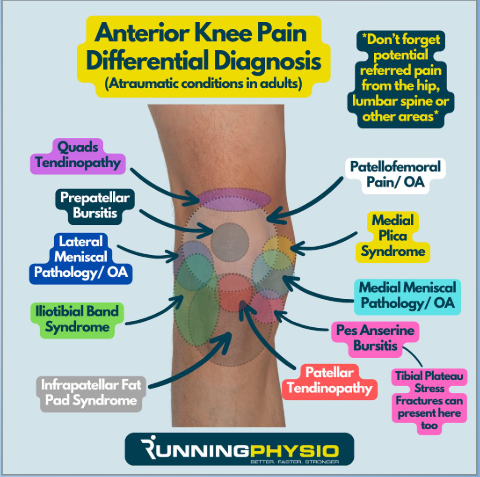
Pain at the front of the knee is really common. The image below highlights the multiple causes of knee pain. There is a link on the blog to an article written about a patient who we were able to help who had been struggling with anterior knee pain.
As there are multiple reasons for the front of your knee to hurt, an assessment will help with a diagnosis and an individual management plan. This can involve exercises, stretches, control work, technique work to offload the front of the knee, taping and soft tissue work, foot strengthening and mobility work. Some people can find insoles beneficial
Hamstring strain
Although not exactly a knee problem, as the hamstrings are in the back of the thigh and help with bending the knee and running they have been included here.
Commonly hamstrings can be injured when sprinting or changing directly. They can be injured by slipping on a wet floor. You can also get tendon problems caused by overload over a long period of time or a sunned increase in activity levels. As the underlying reason is different, different approaches will be needed for treatment.
You will get support to regain range of motion in the knee and hip, rebuild strength in the affected muscle and resilience in the tendon and a plan to return to running and sprinting.
Jumpers Knee/Patellar Tendinopathy
This is caused by an increase in load on the tendon at the bottom of the kneecap/patella before the tendon is ready. It could be due to increasing running distance too quickly while training for a race, increasing the number of steps taken during the day or if you start a new hobby that involved lots of jumping, skipping or walking up and down hills.
Treatment is centred around building tolerance and resilience in the tendon to tolerate load again through a gradual loading program over a number of weeks and months.
